Somewhere between your morning coffee and your doom-scroll, you probably came across a headline that stopped you cold.
Scientists found a way to regrow hair in 56 days.
And if you have been quietly watching your hairline creep backward or spending twenty minutes in the shower staring at what is collecting near the drain — yeah, that headline hit different.
Fifty-six days. Less than two months. The kind of timeline that makes you reach for your wallet before you even finish reading.
But before you do anything else, there is something you need to know. Something the headlines conveniently left out.
The Study That Started It All
The research comes from a team led by Dr. Tsong Min Chang, working alongside a biotech company named Schweitzer Biotech Company (SBC) based in Taiwan. Their goal was to find out whether a plant-based serum, a carefully designed blend of ingredients could push dormant hair follicles back into active growth.
They recruited a group of adult volunteers, divided them into groups, and tracked changes in hair density, thickness, and shedding over eight weeks. Some got the full formula. Some got a partial version. One group got a placebo.
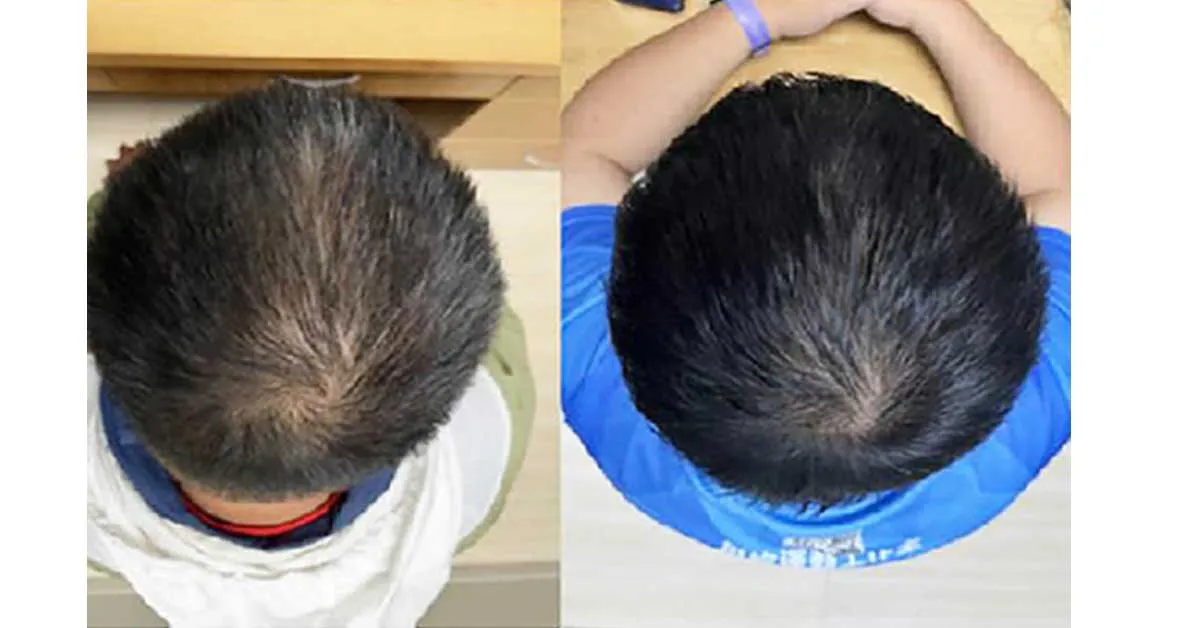
The results, at face value, sounded genuinely exciting. The group using the full serum saw roughly a 25 percent increase in hair density. Hair strands appeared thicker. Scalp appearance improved in several cases.
So far, so good. But here is where it gets complicated.
The Part Nobody Is Talking About
That study involved around 60 people.
Sixty.
In medical research, that is tiny. Not "small but promising" tiny — that is the kind of number that tells you you are looking at a first draft, not a finished answer. Results from small groups can absolutely point in the right direction, but they do not tell you what happens when the same treatment is tried on thousands of different people with different hair types, hormone levels, scalp conditions, and genetics.
Then there is the timeline problem. Eight weeks sounds like a reasonable test period. But hair biology does not work on a two-month clock. Hair grows in cycles that stretch across months, sometimes longer. Early changes can appear and then stabilize, fade, or even reverse. Eight weeks simply does not tell you what happens at month six.
There is also who was in the study. The participants were generally healthy adults — not people with significant, long-established pattern baldness, which is what the majority of people dealing with hair loss are actually trying to treat. That is a meaningful gap between who was studied and who is reading these headlines.
And perhaps the most critical detail: this serum was never tested head-to-head against minoxidil or finasteride, the two treatments that have decades of real-world data behind them. Without that comparison, there is no honest way to say whether this new formula works better, about the same, or just differently.
What "25 Percent More Dense" Actually Looks Like
Here is a question worth sitting with: what does a 25 percent increase in hair density actually look like in the mirror?
The answer depends heavily on where you started. For someone with early, mild thinning, a 25 percent shift might produce a visible, meaningful difference. For someone with significant hair loss, that same percentage gain might be barely noticeable to anyone who is not specifically looking for it.
The before-and-after photos circulating online tend to show the best outcomes, not the average ones. That is not necessarily dishonest, but it is selective. And selective pictures have a long history of making people feel like a breakthrough is closer than it actually is.
Even the researchers running this study are straightforward about its limits. They explicitly call for larger studies, longer observation periods, and direct comparisons with existing treatments. When the scientists themselves are telling you this is not finished yet, that matters.
What Actually Works Right Now
If you are sitting with hair loss today and wondering what your real options are, the answer has not changed much.
Minoxidil, available over the counter in both topical and oral forms remains one of the most widely used and studied hair loss treatments. It will not work for everyone, and it requires consistent use to maintain results. But it has decades of evidence behind it.
Finasteride, a prescription medication, works differently. It targets the hormone most responsible for pattern hair loss in men. Again, not a solution for everyone, but backed by real, long-term research.
Neither of these is glamorous. Neither of them promises results in 56 days. But they are real, and they are understood.
The Bottom Line
A 60-person, eight-week study with no direct comparison to existing treatments is a starting point, a meaningful one, but still a starting point.
The 56-day claim is not a lie. It is just not the full story.
Real breakthroughs in hair loss treatment tend to arrive quietly, after years of accumulated research, not in a single viral headline. And right now, this one is still in the part of the process that happens long before anyone should be adjusting their expectations or their skincare budget.
Keep an eye on it. If larger trials follow and the results hold up, this could eventually become something genuinely worth discussing with a dermatologist.
But for now? Interesting. Promising. And nowhere near finished.
Related: Why Are Doctors Suddenly Recommending This $4 Thing From Walmart?